
How to Register a Private Limited Company in Delhi: 7 Easy Steps (2026 Ultimate Guide)
Table of Contents
If you have decided to register a private limited company in Delhi, you are taking a monumental and strategic step toward long-term business success. As we navigate through 2026, the National Capital Region (NCR) remains the undisputed powerhouse for ambitious startups, tech innovators, traditional enterprises, and aggressive scaling brands in India.
However, turning a brilliant business idea into a legally recognized corporate entity requires navigating the strict legal and regulatory frameworks set forth by the Ministry of Corporate Affairs (MCA). For a first-time founder, the sheer volume of corporate acronyms, DSC, DIN, MOA, AOA, SPICe+, can feel incredibly overwhelming.
The private limited company incorporation process is not something you want to leave to chance, guesswork, or inexperienced consultants. It requires absolute precision, accurate documentation, and strict adherence to government timelines. A single mistake in your filings can lead to weeks of delays or outright rejection by the Registrar of Companies (RoC).
In this ultimate, comprehensive cornerstone guide for 2026, we are going to demystify the entire corporate legal system. We will walk you through exactly how to register a private limited company in Delhi in 7 easy, actionable steps. Furthermore, we will dive deep into the specific statutory documents required, provide an honest breakdown of the hidden and apparent costs, compare this corporate structure to others available, and outline the exact post-incorporation compliances you must follow to keep your business fully compliant with the law.
The 2026 Business Landscape: Why Delhi NCR?
Before looking at the complex legalities and paperwork, it is important to understand why choosing to anchor your corporate entity in Delhi gives you an immediate geographical and economic advantage over other cities. Delhi is not merely the political center of India; it is a sprawling, interconnected web of capital, talent, infrastructure, and global networking.
When you establish your startup registration Delhi 2026, you gain direct access to a massive, affluent consumer market. Furthermore, you tap into a rich talent pool graduating from some of India’s premier educational institutions. The city is also a stone’s throw away from Gurugram and Noida, creating a mega-hub of angel investors, venture capital (VC) firms, and private equity investors.
The physical infrastructure, coupled with aggressive government initiatives pushing for a highly digitized economy, makes company registration in Delhi one of the smartest geographical plays for a new, scalable corporate entity.
What Exactly is a Private Limited Company?
A Private Limited Company (abbreviated as Pvt. Ltd.) is a privately held business entity governed by the rules and regulations of the Indian Companies Act, 2013.
The most important legal characteristic of a Private Limited Company is that it is treated as a “separate legal entity” from its founders and shareholders. In the eyes of the law, the company is an artificial person. This means the company itself can own commercial property, incur business debt, sue other entities, and be sued in its own corporate name.
The “Private” aspect signifies that its shares are held privately by founders and early investors, and they cannot be traded publicly on the open stock market (like the BSE or NSE). The “Limited” aspect refers to the limited financial liability of its shareholders.
To successfully register a private limited company in Delhi, the law mandates a minimum of two directors (the management) and two shareholders (the owners). However, these roles can be, and often are, filled by the exact same two individuals.
Unpacking the Benefits: Why Register a Private Limited Company in Delhi?
Many early-stage founders debate whether they should start their business as a simple sole proprietorship, a traditional partnership firm, or a formal company. While sole proprietorships are undeniably cheaper and faster to start, they offer absolutely zero legal protection. Choosing to register a private limited company in Delhi offers distinct, legally binding advantages that are critical for survival and scale.
1. The Ultimate Shield of Limited Liability
This is the primary, most compelling reason the private limited company incorporation process exists. In a sole proprietorship or traditional partnership, if your business accumulates ₹50 Lakhs in debt, gets sued, and goes bankrupt, your creditors can legally seize your personal assets. Your family home, your personal car, and your life savings are on the line to recover the funds.
In a private limited company, the financial liability of the members is strictly limited to the amount of unpaid shares they hold. If the company fails, your personal wealth and assets remain entirely protected from business creditors.
2. Seamless Access to Institutional Funding and Venture Capital
If you have high-growth ambitions and plan to raise external capital, you must register a private limited company in Delhi. Venture Capitalists (VCs), Angel Investors, and Private Equity firms categorically refuse to invest their funds in sole proprietorships or standard partnerships.
A private limited structure allows for the easy issuance of equity shares, clear dilution of ownership, the creation of employee stock option pools (ESOPs), and strict statutory financial auditing. Investors require this highly regulated structure to ensure their money is safe and their ownership stakes are legally recognized.
3. Unmatched Market Credibility and Brand Trust
Trust is the foundational currency of business. When your business name officially ends with “Private Limited,” it instantly signals to suppliers, enterprise B2B clients, and top-tier talent that you are a serious, highly regulated, and legally compliant organization. Furthermore, government tenders, massive corporate contracts, and international B2B trade agreements often explicitly mandate that participating vendors be registered corporate entities.
4. Perpetual Succession
A private limited company possesses a legal feature called “perpetual succession.” This means the company exists indefinitely until it is formally and legally dissolved through a process called winding up. The life, existence, and operations of the company are not dependent on the life of its human founders. Even if the original directors or shareholders retire, transfer their shares, go bankrupt, or pass away, the corporate entity continues to exist and operate without disruption.
5. Unlocking Exclusive Startup India (DPIIT) Benefits
Once your company registration in Delhi is complete, you will immediately be eligible to apply for official recognition under the government’s Official Startup India Portal.
Startups that receive DPIIT recognition unlock massive, game-changing benefits. These include three-year income tax holidays, fast-tracked patent and trademark applications with up to an 80% government fee rebate, and crucial exemptions from complex angel tax regulations when raising capital.
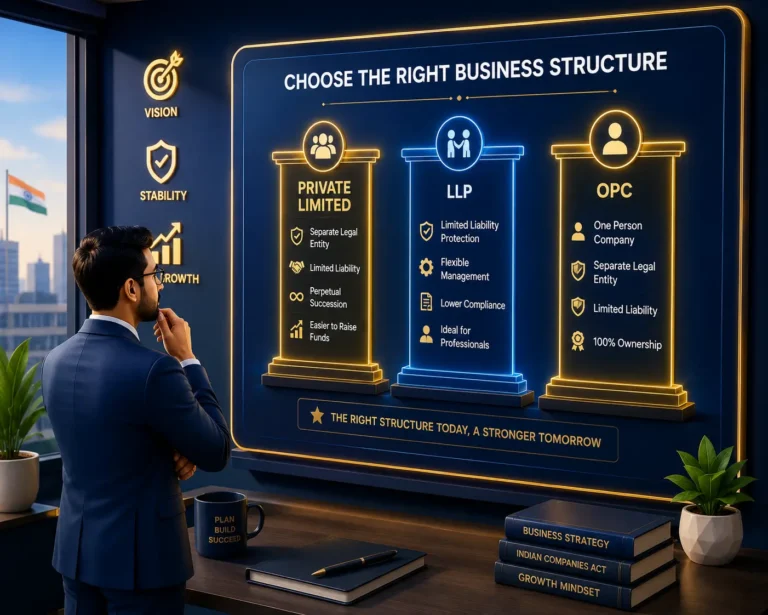
Private Limited vs. LLP vs. OPC: Making the Right Structural Choice
Before you fully commit your time and money to the private limited company incorporation process, let’s briefly compare it to other popular corporate structures available in India to ensure it is the exact right fit for your entrepreneurial vision.
Limited Liability Partnership (LLP)
An LLP is a hybrid structure that combines the limited liability protection of a company with the operational flexibility of a traditional partnership. It generally has fewer ongoing compliance requirements and no mandatory audit requirements until it crosses a specific turnover threshold. The Drawback: LLPs cannot issue equity shares to external investors. This makes them a very poor structural choice if you ever intend to raise angel funding or venture capital.
One Person Company (OPC)
An OPC is a relatively new concept that allows a single, solo founder to register a formal company with limited liability protection. It is great for solo entrepreneurs who want corporate status. The Drawback: It is highly restrictive. If your OPC’s paid-up capital or average turnover crosses a certain statutory threshold, the MCA mandates that you must legally convert it into a regular private limited company anyway.
For 95% of ambitious founders looking to scale aggressively, hire large teams, issue ESOPs, and raise external funds, choosing to register a private limited company in Delhi is the only logical, future-proof path.
Minimum Statutory Requirements for Company Registration in Delhi
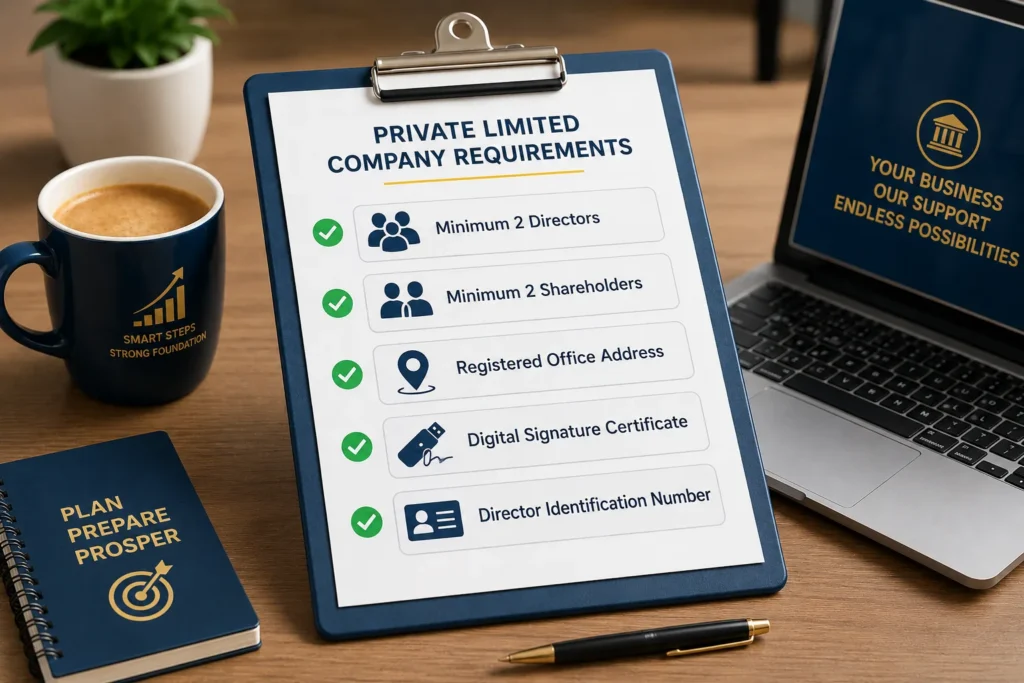
The Ministry of Corporate Affairs (MCA) has defined strict, non-negotiable prerequisites that must be met before you can even log onto the portal to begin the paperwork. To register a private limited company in Delhi, ensure you have the following in place:
- Minimum Directors: You need at least two individual directors to form the corporate board. The maximum allowed by default is 15. Crucially, at least one of these proposed directors must be an Indian resident (defined legally as someone who has lived in India for at least 136 days in the previous financial year).
- Minimum Shareholders (Members): You need at least two shareholders to provide the initial capital. The maximum number of shareholders a private limited company can legally have is 200. As mentioned earlier, the two founding directors can also act as the two primary shareholders.
- Authorized Share Capital: To encourage the ease of doing business, the government has removed the mandatory minimum paid-up capital rule. However, you must still declare an “Authorized Capital” during registration. Most founders start with an authorized capital of ₹1,00,000, which is typically divided into 10,000 equity shares valued at ₹10 each.
- A Registered Office in Delhi: You must have a physical, verifiable address situated within the territory of Delhi to serve as your principal place of business. This is where all official legal notices, tax documents, and communications from the RoC will be sent. It can be a commercial office space, a rented co-working desk, or even a residential home address.
Critical Documents Required for the Private Limited Company Incorporation Process
Having your paperwork perfectly organized beforehand will prevent frustrating rejections and delays from the Registrar of Companies (RoC). Every single document uploaded must be clear, highly legible, and properly self-attested where necessary. Here is exactly what you need to gather to register a private limited company in Delhi.
Documentation for Directors and Shareholders:
- PAN Card: This is an absolute mandatory requirement for all Indian nationals. It serves as your primary identity and tax proof.
- Identity Proof: A clear, scanned copy of an Aadhaar Card, Passport, Voter ID, or Driving License.
- Address Proof: A recent Bank Statement, Electricity Bill, Telephone Bill, or Mobile Postpaid Bill. Crucial Note: This document must absolutely not be older than 2 months, and the name printed on it must exactly match the name on the PAN card.
- Photographs: Recent, clear, passport-sized photographs of all proposed directors.
Documentation for the Delhi Registered Office:
- Utility Bill: An electricity bill, water bill, or broadband internet bill for the specific premises you intend to use. Again, this must not be older than 2 months.
- No Objection Certificate (NOC): A formally drafted and signed document from the legal owner of the property stating they have absolutely no objection to the premises being used as the registered corporate office of your new company.
- Proof of Ownership/Occupancy: If you own the property, the property deed or tax receipt. If rented, a formalized, notarized Rent Agreement along with a copy of the property owner’s PAN card.
7 Easy Steps to Register a Private Limited Company in Delhi (The 2026 SPICe+ Process)
The Government of India has drastically modernized and digitized the private limited company incorporation process. The traditional, archaic method of physical multi-form submission has been entirely replaced by the powerful SPICe+ (Simplified Proforma for Incorporating Company Electronically Plus) web application on the MCA portal. Here is the exact, step-by-step 7-stage roadmap.
Step 1: Obtain Class 3 Digital Signature Certificates (DSC)
Because the entire process to register a private limited company in Delhi is conducted online via a secure web portal, you cannot sign legal forms with a physical pen. You must obtain a Class 3 Digital Signature Certificate (DSC) for every proposed director and shareholder.
A DSC is a highly secure, encrypted USB token that acts as your digital legal identity. Authorized Certifying Authorities (CAs) issue these tokens only after a strict video KYC and document verification process.
Step 2: Apply for Director Identification Numbers (DIN)
A Director Identification Number (DIN) is a unique, lifetime 8-digit identification code allotted by the central government to anyone intending to serve as a company director. You cannot legally act as a director without one.
While you can technically apply for a DIN separately via Form DIR-3, the modern SPICe+ system is built for efficiency. You can now apply for up to three DINs simultaneously during the actual incorporation filing within the SPICe+ form itself, saving both time and application fees.
Step 3: Company Name Approval (SPICe+ Part A)
Your company’s name is its primary identity in the market. The first section of the SPICe+ web form (Part A) is dedicated entirely to name reservation, utilizing the RUN (Reserve Unique Name) service. You can submit two preferred names in order of priority, along with a brief description of your main business activity.
The MCA is notoriously strict regarding corporate name approvals. Your proposed name must be highly unique, not overly similar to any existing companies or LLPs, and must not infringe on any registered trademarks. If you are struggling to build a unique corporate identity that clears MCA regulations, our expert team at PC Media House offers premium branding and design services to ensure your brand is both highly marketable and legally viable.
Step 4: Drafting the MOA and AOA (SPICe+ Part B)
Once the Registrar approves your company name, it is reserved for 20 days. Within this strict window, you must proceed to file SPICe+ Part B. This is the most legally complex and critical part of the private limited company incorporation process, as it involves drafting your foundational charter documents:
- Memorandum of Association (MOA – Form INC-33): This is the supreme constitution of your company. It defines the company’s relationship with the outside world, declares its authorized share capital, and strictly outlines the primary business objectives and activities it is legally permitted to pursue.
- Articles of Association (AOA – Form INC-34): This document governs the internal rules and management of the company. It dictates the regulations regarding the issuance of shares, the conduction of board meetings, the rights and duties of shareholders, and the specific powers granted to the directors.
Step 5: Master Filing via Agile-Pro-S
In the past, founders had to visit multiple different government departments after incorporation to get their tax IDs and bank accounts. Today, the MCA has brilliantly integrated these steps into a master web form called Agile-Pro-S, which is filed seamlessly alongside SPICe+ Part B.
By submitting this single, powerful form, you simultaneously apply for:
- The Company’s PAN (Permanent Account Number).
- The Company’s TAN (Tax Deduction and Collection Account Number).
- Mandatory EPFO (Employees’ Provident Fund) registration.
- Mandatory ESIC (Employees’ State Insurance) registration.
- Professional Tax Registration (required depending on state rules).
- The opening of your corporate bank account (you can select from a drop-down list of integrated banking partners directly in the form).
Step 6: Government Verification and Fee Payment
Once all the web forms (Part B, e-MOA, e-AOA, and Agile-Pro) are perfectly filled out, they are downloaded as PDF documents. The founding directors and professionals (CA/CS) must then attach their secure Digital Signatures (DSCs) to these PDFs using a specialized software tool.
Once digitally signed, the forms are uploaded back to the Ministry of Corporate Affairs (MCA) portal. Finally, you must pay the requisite government fees, which include processing charges and state-specific stamp duty based on your authorized capital.
Step 7: The Issuance of the Certificate of Incorporation (CoI)
The Registrar of Companies (RoC) at the Central Registration Centre (CRC) will thoroughly review your entire application packet. If your documents are flawless, your NOCs are valid, and the SPICe+ forms match perfectly, the RoC will approve the application.
You will then be officially issued a digital Certificate of Incorporation (CoI). This beautiful, highly important document features your official Corporate Identity Number (CIN), date of incorporation, and the company PAN and TAN. Congratulations! You have successfully managed to register a private limited company in Delhi.

What is the Cost of Company Registration in Delhi?
Accurate financial planning is critical for early-stage startups. A major concern for new founders is understanding the exact cost of company registration in Delhi. The good news is that the Indian government has actively worked to lower the financial barriers to entrepreneurship over the last few years.
As of 2026, the MCA has completely waived the standard government incorporation processing fee for companies that have an authorized capital of up to ₹15,00,000. However, “zero incorporation fee” does not mean the entire process is free. You must still budget and account for the following mandatory expenses:
- Digital Signature Certificates (DSC): Securing a highly encrypted Class 3 DSC token typically costs between ₹1,000 to ₹2,500 per director, depending on the specific certifying agency you use.
- Stamp Duty and Notary Charges: Stamp duty is a state tax paid directly to the Delhi state government. The exact cost fluctuates based on the amount of authorized capital you declare in your MOA. Additionally, legally notarizing rental agreements or affidavits incurs minor out-of-pocket costs.
- PAN and TAN Generation Fees: Nominal government processing fees (usually under ₹200) apply for generating your corporate tax identity numbers.
- Professional Consulting Fees (The Real Cost): Unless you are a highly experienced practicing chartered accountant yourself, you cannot navigate the complexities of drafting a legally sound MOA/AOA, ensuring form compliance, or filing SPICe+ forms alone. Hiring a CA, CS, or legal agency is practically mandatory. Professional fees for managing the end-to-end process generally range from ₹6,000 to ₹15,000, depending on the agency’s expertise and turnaround time.
To avoid hidden costs, surprise fees, and regulatory headaches, ambitious founders rely on PC Media House. We provide premium, fully transparent business registration services that handle the entire private limited company incorporation process from start to finish without hidden markups.
Critical Post-Incorporation Compliances for Delhi Startups
One of the biggest, most expensive mistakes first-time founders make is assuming the work ends once they successfully register a private limited company in Delhi. In reality, incorporation is just the beginning of your legal journey. A private limited company exists in a highly regulated, transparent environment, and the MCA demands strict ongoing compliance. Failing to meet these deadlines can result in massive financial penalties, director disqualification, or the forced striking off (closure) of the company.
Immediate Post-Incorporation Tasks (First 30 to 180 Days)
- Activate the Corporate Bank Account: You must visit the bank branch to complete the physical KYC process and officially activate the account created during the Agile-Pro filing.
- Deposit the Share Capital: Within the first 180 days, every shareholder must transfer their committed share capital amount (e.g., ₹50,000 each) directly from their personal accounts into the newly opened corporate bank account.
- Appoint the First Auditor: The Board of Directors must hold a meeting and appoint the company’s first statutory auditor (a practicing Chartered Accountant) within exactly 30 days of receiving the Certificate of Incorporation.
- File Form INC-20A (Commencement of Business): Once the share capital is deposited, the company must file a formal declaration of Commencement of Business (Form INC-20A) with the RoC within 180 days. You cannot legally start business operations, sign major contracts, or borrow money until this specific form is filed.
Annual Mandatory Corporate Compliances
- Statutory Board Meetings: The company must legally hold and document a minimum of four Board of Directors meetings every financial year, ensuring the gap between any two consecutive meetings does not exceed 120 days.
- Annual General Meeting (AGM): The company must hold one AGM every year to discuss financials, auditor reports, and business progress with all the shareholders.
- RoC Annual Returns: The company must file its audited financial statements (Form AOC-4) and its detailed annual return (Form MGT-7) with the MCA every single year. This must be done regardless of whether the business made a massive profit, suffered a loss, or even had zero revenue.
- Corporate Income Tax Returns (ITR): Corporate tax returns must be filed annually and accurately through the official Income Tax Department Portal.
Managing these stringent, unforgiving timelines while trying to scale a new business is exhausting for founders. For complete operational peace of mind, PC Media House provides ongoing, expert taxation and compliance services, ensuring your business never misses a deadline, fails an audit, or faces a government penalty.
Common Mistakes to Avoid During the Incorporation Process
To ensure your startup registration Delhi 2026 goes smoothly and without delays, avoid these frequent, costly pitfalls that cause immediate MCA rejections:
- Choosing a Generic or Conflicting Name: Submitting a proposed name that contains common, generic words without a highly unique prefix will almost certainly be rejected by the RoC for lack of distinctiveness. Always check the MCA trademark database first.
- Mismatched Identity Documents: The exact spelling of your name, your father’s name, and your date of birth must match perfectly across your PAN card, Aadhaar card, and bank statements. Even a missing middle initial or a slight typo will cause an immediate form rejection.
- Using an Unverified or Fake Address: Providing a registered office address without a proper, verifiable utility bill or uploading a forged NOC is illegal and will lead to the immediate cancellation of your application and potential legal action.
- Ignoring the 180-Day Rule: Forgetting to deposit share capital and file Form INC-20A within 180 days will result in a severe penalty of ₹50,000 for the company itself, plus an additional ₹1,000 per day for the directors.
Why PC Media House is Your Ultimate Growth Partner in 2026
At PC Media House, we are fundamentally different from traditional, old-school CA firms or standard document-pushing registration agencies. We are a comprehensive, modern digital growth and business execution partner.
We deeply understand that choosing to register a private limited company in Delhi is merely step one on a much longer journey. Once your legal foundation is secure, the real, difficult battle begins—acquiring paying customers, building market trust, establishing a brand presence, and generating consistent revenue.
Because we operate as premier digital marketing experts in Delhi, we seamlessly transition your newly incorporated company directly into the highly competitive digital space. From crafting an incredible, trustworthy brand identity and building a high-converting, lightning-fast custom website, to deploying powerful, lead-generating digital marketing services, we handle your entire growth ecosystem under one unified roof.
You do not have to endure the stress of juggling a CA for your taxes, a freelancer for your website code, and an external agency for your social media ads. PC Media House unifies your legal strategy, corporate compliance, and digital marketing execution, allowing you as the founder to focus entirely on what matters most: scaling your core product and managing your team.
Ready to Start Your Corporate Journey?
Learning how to register a private limited company in Delhi is the first, most crucial step toward building a lasting, highly profitable corporate legacy. With the right legal architecture, external funding capabilities, and solid market credibility, your business is primed for aggressive, unstoppable scale.
However, the private limited company incorporation process demands absolute, uncompromising accuracy. Do not let complex MCA regulations, confusing SPICe+ electronic forms, or the paralyzing fear of post-incorporation financial penalties slow down your entrepreneurial vision.
Let the seasoned, meticulous experts at PC Media House handle the heavy lifting for you. We will manage your complex paperwork, ensure flawless regulatory compliance, and prepare your brand for a massive digital launch in the market.
Contact PC Media House today for a free strategic consultation, and let’s officially register your private limited company in Delhi this week!
Frequently Asked Questions (FAQs) About Company Registration in Delhi
1. How long does it exactly take to register a private limited company in Delhi?
If all your documents (PAN, Aadhaar, bank statements, utility bills) are perfectly accurate, properly self-attested, and readily available, you can successfully register a private limited company in Delhi within 7 to 10 working days using the MCA’s fast-track SPICe+ web portal.
2. Can I legally register a private limited company at my residential home address in Delhi?
Yes, you can absolutely use a residential home address as your company’s official registered office. The MCA does not legally mandate that you rent an expensive commercial office space. You will simply need to provide a recent utility bill (electricity or water) and a signed No Objection Certificate (NOC) from the legal owner of the residential property.
3. Do I have to be physically present in a government office in Delhi to register my company?
No, the entire private limited company incorporation process is 100% online and digitized by the Central Government. Physical presence at an RoC office is not required at any stage. All SPICe+ forms are filed electronically online, and they are legally authorized using encrypted Digital Signature Certificates (DSC) from the comfort of your home or office.
4. What is the statutory minimum capital required for company registration in Delhi?
To encourage startups and the ease of doing business, the government has relaxed previous rules. There is no statutory minimum paid-up capital requirement to register a private limited company in Delhi anymore. However, an “authorized capital” must still be declared in your MOA, which traditionally starts at a standard baseline of ₹1,00,000.
5. Is GST registration mandatory immediately after my company is incorporated?
No, GST registration is not legally mandatory immediately upon incorporation. You only need to register for a GST number if your business turnover exceeds the government threshold limit (currently ₹20 Lakhs for service providers and ₹40 Lakhs for physical goods) OR if you plan to engage in inter-state trade or e-commerce operations (selling on Amazon, Flipkart) from day one.
6. Can an NRI or a foreign national become a director in a Delhi-based private limited company?
Yes, a Non-Resident Indian (NRI) or a foreign national can absolutely become a director and a shareholder in an Indian private limited company. However, the law strictly mandates that at least one director on the board must be an Indian Resident (someone who has stayed in India for at least 136 days in the previous financial year). The foreign national will need to provide notarized and apostilled passport and address proof documents.
7. What happens if I fail to deposit the share capital within 180 days?
If the founding shareholders fail to deposit their committed share capital into the corporate bank account and do not file Form INC-20A within 180 days of incorporation, the MCA imposes severe penalties. The company is fined ₹50,000, and each director is fined ₹1,000 for every day the default continues. Furthermore, the RoC has the power to initiate action to strike off the company’s name from the register.
8. Can two family members or a married couple form a private limited company together?
Yes, there is absolutely no legal restriction against family members starting a company. A husband and wife, or two siblings, can easily act as the two minimum required directors and the two minimum required shareholders to complete the private limited company incorporation process.
9. What is the difference between Authorized Capital and Paid-Up Capital?
Authorized Capital is the maximum maximum amount of share capital that the company is legally authorized to issue to shareholders according to its MOA. Paid-Up Capital is the actual, real money that the shareholders have transferred into the company’s bank account against the shares issued to them.
10. Do I need to hire a full-time auditor for my new startup?
No, you do not need to hire a full-time, in-house auditor. However, you are legally required to appoint an external, practicing Chartered Accountant (CA) or a CA firm as your statutory auditor within 30 days of incorporation to review your annual financials. They will work for you on a retainer or per-audit fee basis.
11. Can a private limited company exist without any employees?
Yes, a private limited company can legally exist and operate with zero employees. The only human requirements are the minimum two directors to manage the company. Many early-stage startups and holding companies operate for months or years with only the founding directors executing all the work before hiring formal employees.
12. How do I protect my company name after incorporation?
While incorporating your company prevents anyone else from registering the exact same corporate name with the MCA, it does not stop them from using it as a brand name. To gain absolute, exclusive nationwide rights to your business name, logo, and brand identity, you must separately file for Trademark Registration under the Trademarks Act, 1999.