
Pvt Ltd vs LLP vs OPC: 7 Crucial Facts to Choose the Best Business Structure
Table of Contents
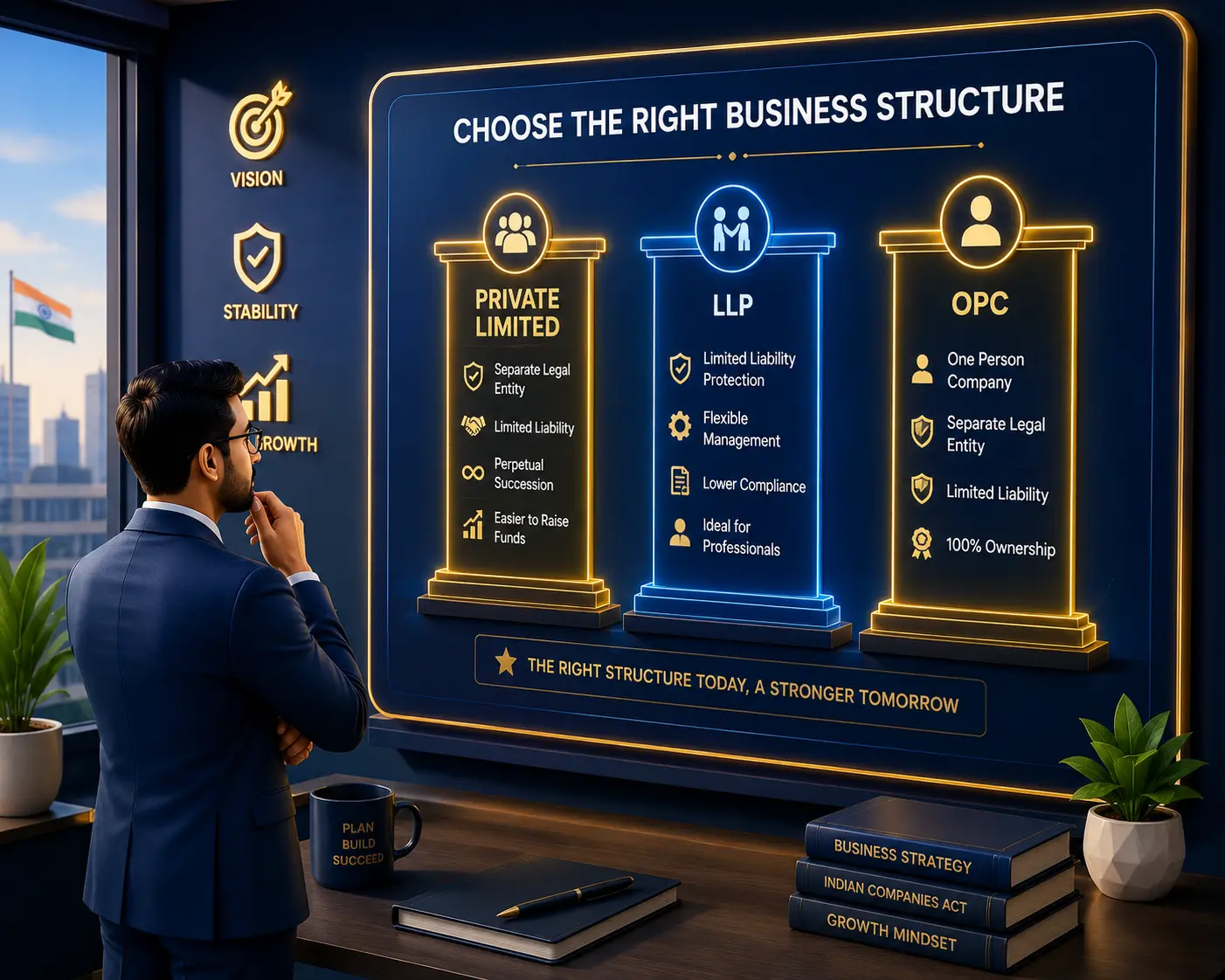
When you finally decide to turn your brilliant idea into a legally recognized reality, you immediately hit a massive administrative roadblock. You must decide on your legal entity. For modern Indian founders, the debate almost always boils down to Pvt Ltd vs LLP vs OPC.
Choosing the right legal framework is not just a standard paperwork exercise. It is the most critical foundational decision you will make for your business. The structure you choose directly dictates your personal financial liability, your ability to raise venture capital, your annual compliance burden, and the amount of corporate tax you will pay to the government.
Unfortunately, many first-time founders rush into this decision. They choose a structure based on what is cheapest to register today, without considering the massive legal headaches it will cause three years down the line when they try to scale or bring in investors.
At PC Media House, we guide hundreds of entrepreneurs through this exact dilemma every year. In this massive, comprehensive cornerstone guide, we are going to tear down the confusion surrounding the Pvt Ltd vs LLP vs OPC debate.
We will explore the deep legal nuances of each structure, provide a highly shareable comparison table, analyze the real-world tax implications, and give you a definitive framework to choose the right business structure for your specific vision.
The Foundation: Why Your Business Structure Matters
Before we dive into the specific differences between a Private Limited Company, a Limited Liability Partnership, and a One Person Company, you must understand what is actually at stake.
Your business structure is the legal DNA of your company. It determines how the government, the courts, the tax department, and external investors view your business.
If you choose incorrectly, you might find yourself legally blocked from issuing employee stock options (ESOPs). You might face a sudden, mandatory conversion process that halts your operations for months. Or worse, you might end up paying thousands of rupees in unnecessary compliance penalties simply because you chose a structure that was too heavy for your current revenue level.
The goal of this guide is to future-proof your business. Whether you are building the next massive tech unicorn or a highly profitable boutique consulting firm, understanding the Pvt Ltd vs LLP vs OPC landscape is your first step toward responsible entrepreneurship.
Deep Dive 1: The Private Limited Company (Pvt Ltd)
The Private Limited Company is the undisputed gold standard of corporate structures in India. Governed by the strict regulations of the Companies Act, 2013, it is the most popular, trusted, and highly regulated entity type available to founders.
What is a Pvt Ltd Company?
A Private Limited Company is a separate legal entity from its founders. It requires a minimum of two directors to manage the company and two shareholders to own the equity. The financial liability of the shareholders is strictly limited to the amount of unpaid share capital they hold.
The Major Advantages of a Pvt Ltd
- The Venture Capital Magnet: If you ever plan to raise money from Angel Investors or Venture Capitalists (VCs), you absolutely must register a Private Limited Company. Institutional investors will not invest in LLPs or OPCs because those structures cannot easily issue equity shares or accommodate complex cap tables.
- Startup India Benefits: Private Limited companies are highly favored by the Department for Promotion of Industry and Internal Trade (DPIIT). Registering this entity makes it incredibly easy to apply via the Official Startup India Portal to unlock massive tax holidays and angel tax exemptions.
- Unmatched Credibility: Suppliers, enterprise B2B clients, and top-tier talent inherently trust the “Pvt Ltd” tag. It signals that your business is highly regulated, frequently audited, and legally stable.
- ESOP Issuance: Only a Private Limited company can easily create Employee Stock Ownership Plans (ESOPs) to attract and retain top-tier talent without draining cash reserves.
The Disadvantages of a Pvt Ltd
- High Compliance Burden: This is the heaviest structure to maintain. You must hold four documented board meetings a year, conduct mandatory statutory audits by a CA (regardless of revenue), and file complex annual returns (AOC-4 and MGT-7) with the Ministry of Corporate Affairs (MCA).
- Higher Registration Costs: Compared to an LLP or OPC, the initial professional fees and state stamp duties to register a private limited company are generally higher.
For founders looking to build a highly scalable, fundable, and nationally recognized brand, leveraging expert business registration services in Delhi to set up a Pvt Ltd is the smartest move.
If you have decided that a Pvt Ltd is the perfect fit for your startup, check out our complete 2026 guide on how to register a private limited company in Delhi in 7 easy steps.
Deep Dive 2: The Limited Liability Partnership (LLP)
The Limited Liability Partnership (LLP) was introduced in India in 2008 to bridge the gap between a traditional, highly risky partnership firm and a heavily compliant Private Limited Company.
What is an LLP?
An LLP is an alternative corporate business form that gives the benefits of limited liability of a company alongside the flexibility of a partnership. To begin an LLP company registration, you need a minimum of two designated partners. Unlike a Pvt Ltd, there are no “shares” or “shareholders”—ownership is determined by the percentage of capital contribution outlined in the LLP Agreement.
The Major Advantages of an LLP
- Lower Compliance Burden: This is the biggest selling point of an LLP. Unlike a Pvt Ltd, an LLP does not require mandatory board meetings. Furthermore, a statutory financial audit is only mandatory if the LLP’s annual turnover crosses ₹40 Lakhs or its capital contribution exceeds ₹25 Lakhs.
- Operational Flexibility: The internal management of an LLP is governed entirely by the LLP Agreement, which you draft yourselves. You are not bound by the rigid internal management rules of the Companies Act.
- No Dividend Distribution Tax (DDT) Issues: Profits can be easily withdrawn by the partners according to their profit-sharing ratio without the complex dividend distribution headaches faced by corporate entities.
The Disadvantages of an LLP
- Zero Equity Funding: This is the ultimate dealbreaker for tech startups. Because an LLP does not have equity shares, you cannot give a venture capitalist a 10% equity stake in exchange for funding. VCs generally refuse to invest in LLPs.
- Higher Tax Rate Base: While LLPs avoid certain corporate surcharges, they are subjected to a flat 30% income tax rate, whereas certain new Private Limited manufacturing companies can enjoy tax rates as low as 15% to 22% under modern tax regimes.
An LLP is the absolute perfect structure for professional service providers, law firms, digital marketing agencies, family-owned businesses, and B2B consultants who want limited liability but do not want the headache of heavy corporate compliance.
Deep Dive 3: The One Person Company (OPC)
The One Person Company (OPC) is a relatively new concept introduced in the Companies Act, 2013. It was designed specifically to support solo entrepreneurs and bring the massive unorganized sector of sole proprietorships into the formal corporate framework.
What is an OPC?
As the name suggests, an OPC is a company that has only one single person as a member (shareholder). You act as the 100% owner and the sole director. However, you are legally required to nominate a “Nominee”—a trusted person who will inherit the company in the event of your death or incapacity.
The Major Advantages of an OPC
- Solo Power with Corporate Status: You do not need to find a co-founder just to meet the legal requirement of having two directors. You get complete operational control while still enjoying the prestigious “Private Limited” suffix at the end of your company name (e.g., “TechSolutions OPC Private Limited”).
- Limited Liability for Solopreneurs: Unlike a standard sole proprietorship where your personal assets are at risk, an OPC protects your personal wealth from business debts.
- Better Access to Bank Loans: Banks heavily prefer lending to OPCs over sole proprietorships because OPCs have a legally verifiable corporate identity and follow formal accounting standards.
The Disadvantages of an OPC
- Mandatory Conversion Triggers: This is the biggest hidden trap of an OPC. If your paid-up share capital exceeds ₹50 Lakhs OR your average annual turnover over three years exceeds ₹2 Crores, you are legally forced to convert the OPC into a regular Private Limited Company. This transition can disrupt operations.
- No External Equity Funding: Because you are the sole 100% shareholder by law, you cannot issue shares to external investors or co-founders without converting the entity first.
- High Compliance for a Solo Founder: Despite being a one-person show, an OPC must still file audited financial statements and annual returns with the MCA, which can be expensive and time-consuming for a single individual.
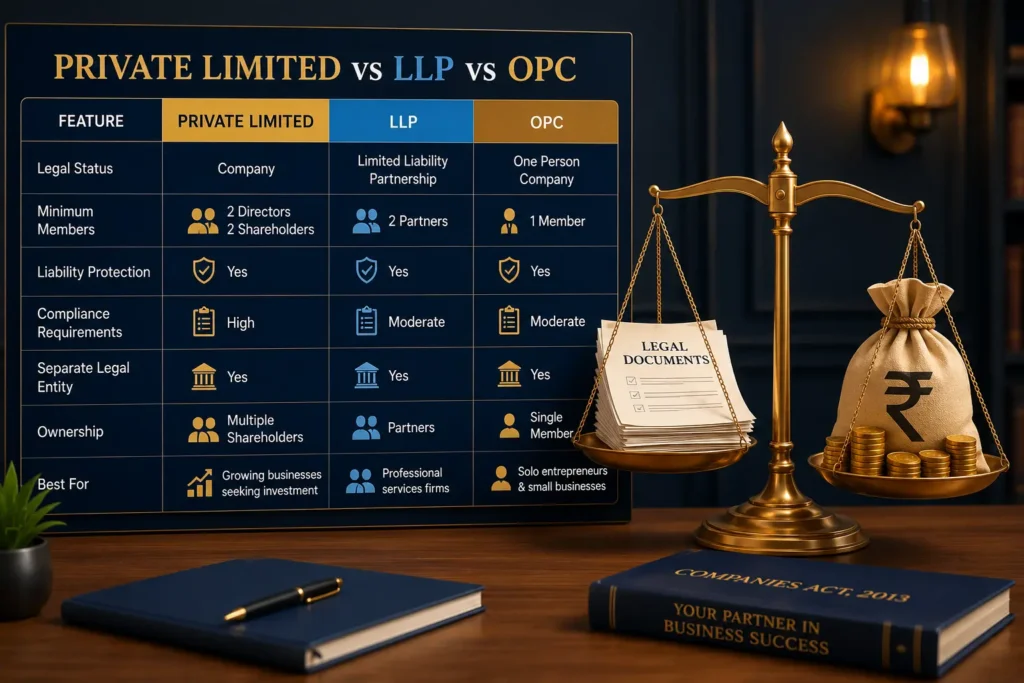
The Ultimate Comparison Table: Pvt Ltd vs LLP vs OPC
To make this decision drastically easier, we have compiled the definitive comparison table. This is the exact framework we use at PC Media House when helping founders choose the right business structure.
| Feature | Private Limited (Pvt Ltd) | Limited Liability Partnership (LLP) | One Person Company (OPC) |
| Minimum Owners | 2 Shareholders | 2 Partners | 1 Shareholder |
| Maximum Owners | 200 Shareholders | Unlimited | 1 Shareholder |
| Minimum Directors | 2 Directors | 2 Designated Partners | 1 Director |
| Personal Liability | Limited to unpaid shares | Limited to capital contribution | Limited to unpaid shares |
| Equity Funding (VCs) | Extremely Easy & Highly Preferred | Impossible (No shares to issue) | Impossible (Must convert first) |
| Statutory Audit | Mandatory (regardless of turnover) | Mandatory only if Turnover > ₹40L or Capital > ₹25L | Mandatory (regardless of turnover) |
| Board Meetings | Minimum 4 per year | Not legally required | Minimum 2 per year |
| ESOP Issuance | Yes | No | No |
| Foreign Investment (FDI) | Allowed (Automatic Route for most sectors) | Allowed (Under specific conditions) | Not Allowed |
| Ideal For | High-growth startups, Tech firms, Companies seeking funding | Agencies, Consultants, Professional Services, Family Businesses | Solo founders, Freelancers transitioning to a corporate structure |
Head-to-Head: The Funding Perspective
When analyzing the Pvt Ltd vs LLP vs OPC debate, funding is usually the deciding factor for ambitious startups.
If your business model requires burning cash to acquire users, building complex software, or setting up massive manufacturing units, you will eventually need external capital. Venture Capitalists rely on highly structured equity financing models. They buy “preference shares” that come with specific voting rights, anti-dilution clauses, and board seats.
A Private Limited Company is the only structure on this list that can legally and seamlessly issue these types of shares. Furthermore, if you want to attract top engineers from Google or Microsoft to your new startup, you cannot pay them matching corporate salaries. Instead, you offer them Employee Stock Ownership Plans (ESOPs). Only a Pvt Ltd can efficiently issue ESOPs.
If funding is in your 5-year plan, end the debate now. Register a Private Limited Company.
Head-to-Head: The Compliance and Taxation Reality
Compliance is the hidden cost of doing business in India. Let’s look at how the government treats these entities.
The LLP Advantage: For a bootstrapped service business, compliance costs can eat into profit margins. An LLP offers a massive advantage here. If your digital marketing agency operates as an LLP and makes ₹30 Lakhs in a year, you do not need to hire a CA to conduct a mandatory statutory audit. You simply file Form 8 (Statement of Account & Solvency) and Form 11 (Annual Return).
The Pvt Ltd Burden: A Private Limited Company must undergo a statutory audit by a practicing Chartered Accountant even if the company made zero rupees in revenue. You must file AOC-4 and MGT-7. You must maintain highly detailed statutory registers and minute books for all board meetings.
Taxation Nuances: Corporate taxation is incredibly complex and frequently updated by the Income Tax Department. Currently, domestic Private Limited companies can opt for concessional tax rates (around 22% plus surcharge/cess) under specific sections of the Income Tax Act, provided they forego certain exemptions. LLPs, on the other hand, are generally taxed at a flat 30%.
To navigate these treacherous financial waters, you need expert taxation and compliance services to ensure you optimize your tax outflow without breaking the law.

The OPC Trap: Why Solo Founders Eventually Convert
The OPC was introduced with great fanfare, but in practical reality, it serves as a temporary stepping stone rather than a permanent destination.
If you are a solo software developer starting a SaaS company, an OPC seems perfect. You get the limited liability protection to shield your personal savings, and you do not need to dilute 50% of your equity to a random co-founder just to meet the legal requirements.
However, the moment your software takes off and your revenue crosses ₹2 Crores, the Ministry of Corporate Affairs (MCA) forces your hand. You must legally alter your Memorandum of Association (MOA), find a second director, find a second shareholder, and convert to a standard Pvt Ltd.
Many founders find this mandatory conversion process distracting and expensive. If you anticipate rapid growth, it is often much wiser to simply find a trusted family member to hold a nominal 1% share and register a standard Private Limited Company from day one.
Protecting Your Intellectual Property
Regardless of whether you choose a Pvt Ltd, LLP, or OPC, simply registering the company name with the MCA does not give you absolute ownership of the brand name in the open market.
To prevent competitors from stealing your logo, your brand name, or your specific product designs, you must file for separate intellectual property protection under the Trademarks Act. Your business structure protects your liability; your trademark protects your brand identity.
At PC Media House, our integrated approach ensures that when we handle your incorporation, we also actively secure your brand through our dedicated legal and IPR services.
The Final Verdict: Which Should You Choose?
The Pvt Ltd vs LLP vs OPC decision does not have a one-size-fits-all answer. It requires a brutally honest assessment of your business goals over the next five years. Here is the definitive decision-making framework:
Choose a Private Limited Company if:
- You plan to raise money from Angel Investors or Venture Capitalists.
- You want to offer ESOPs to attract high-level talent.
- You are building a high-growth tech startup, manufacturing unit, or scalable B2C brand.
- You want the absolute highest level of market credibility and trust.
Choose a Limited Liability Partnership (LLP) if:
- You are starting a B2B service business, a consulting firm, a digital agency, or a law practice.
- You plan to bootstrap the business using your own profits and never intend to raise external equity funding.
- You want to keep annual compliance costs and administrative headaches to an absolute minimum.
- You are running a tightly knit family business where profit distribution needs to be simple.
Choose a One Person Company (OPC) if:
- You are a fiercely independent solo founder, freelancer, or sole proprietor who wants corporate legal protection.
- You cannot find (or do not want) a second director or shareholder to join your venture.
- You expect your annual turnover to remain comfortably below the ₹2 Crore mandatory conversion threshold for the foreseeable future.
Ready to Incorporate Your Business?
Deciding on the correct legal structure is complex, but the actual execution should not be. You should be focused on building your product, finding your first 100 customers, and refining your market pitch—not agonizing over SPICe+ web forms, DIN applications, and confusing MCA legal jargon.
If you are ready to formally register your business in Delhi NCR, you need a partner who understands both corporate law and business scale. As a premier digital and corporate growth agency, we do not just file your paperwork. We help you build a massive brand identity, optimize your digital presence through elite digital marketing services, and keep your company legally flawless.
Stop letting administrative fear delay your entrepreneurial journey.
Contact PC Media House today for a free consultation, and let our experts handle your entire company registration process seamlessly!
Frequently Asked Questions (FAQs) About Business Structures
1. Is a Private Limited Company better than an LLP for startups?
Yes, for scalable startups, a Private Limited Company is significantly better. Institutional investors, VCs, and angel investors heavily prefer the Pvt Ltd structure because it allows for the easy issuance of equity shares, the creation of ESOP pools, and provides a highly regulated environment for their investments. LLPs cannot issue equity shares.
2. Can I convert my LLP into a Private Limited Company later?
Yes, you can legally convert an LLP into a Private Limited Company later under the provisions of the Companies Act, 2013. However, the legal conversion process involves heavy paperwork, asset valuation, and MCA approvals, which can be time-consuming and expensive. It is generally better to start as a Pvt Ltd if funding is in your future.
3. What is the mandatory conversion rule for an OPC?
If a One Person Company (OPC) exceeds a paid-up share capital of ₹50 Lakhs OR its average annual turnover over the preceding three consecutive financial years exceeds ₹2 Crores, it is legally mandated by the MCA to convert into either a Private Limited Company or a Public Limited Company within 6 months.
4. Which business structure has the lowest compliance cost?
Between the three major corporate entities, the Limited Liability Partnership (LLP) has the lowest annual compliance cost. It does not require mandatory board meetings, and a statutory financial audit by a CA is only required if the turnover crosses ₹40 Lakhs or the capital contribution crosses ₹25 Lakhs.
5. Do I need a commercial office space to register any of these structures?
No, the MCA does not mandate a commercial office space for business registration. You can legally register a Pvt Ltd, LLP, or OPC at a residential home address in India. You will simply need to provide a recent utility bill and a No Objection Certificate (NOC) from the legal owner of the property.
6. Can an NRI or foreign national start a Private Limited Company in India?
Yes, a Non-Resident Indian (NRI) or a foreign national can absolutely incorporate a Private Limited Company in India subject to Foreign Direct Investment (FDI) guidelines. However, at least one director on the corporate board must be an Indian Resident (someone who has stayed in India for at least 136 days in the previous financial year).
7. What is the difference in taxation between a Pvt Ltd and an LLP?
Taxation is complex, but generally, LLPs are taxed at a flat rate of 30% on their profits. Private Limited Companies have access to concessional corporate tax rates (which can be as low as 15% to 22% for certain new manufacturing or domestic companies) under specific sections of the Income Tax Act, provided they do not claim certain other deductions.
8. Can a Private Limited Company exist with zero employees?
Yes, a Private Limited Company can legally exist and operate with zero formal employees. The only human requirement is the minimum two directors required to manage the company. Many holding companies and early-stage startups operate for a long time with only the founding directors executing all the operational work.
9. Why is a Digital Signature Certificate (DSC) required for registration?
Because the entire company registration process in India is now completely digitized by the MCA, physical signatures on paper are no longer accepted for incorporation forms. A Class 3 Digital Signature Certificate (DSC) is a highly secure, encrypted USB token used by directors and partners to legally and digitally sign all electronic government forms.
10. Does registering my company name automatically give me a trademark?
No. Registering your company name (e.g., “Apex Tech Pvt Ltd”) with the MCA simply prevents another entity from registering the exact same corporate name. It does not give you exclusive, nationwide intellectual property rights to use that name as a consumer brand. For complete brand protection, you must separately file for a Trademark under the Trademarks Act, 1999.