
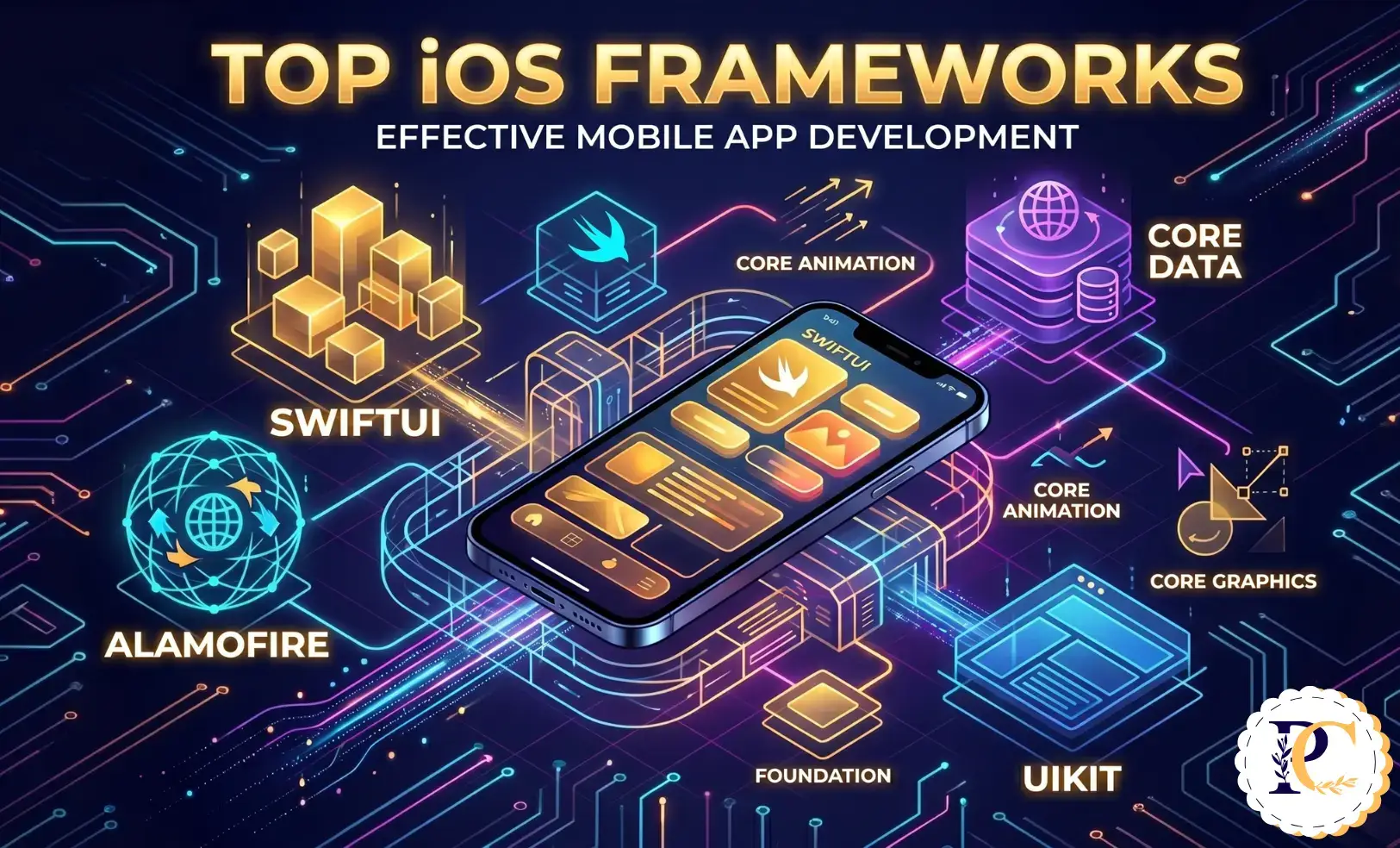
Top iOS Frameworks: 11 Best Tools for Elite App Development in 2026
Choosing the top iOS frameworks is the single most important technical decision you will make before writing your first line of Swift code. In 2026, the Apple ecosystem is more powerful—and more fragmented—than ever before. If you are building a mobile application for a startup in Delhi or a global enterprise, your choice of framework will dictate your app’s speed, security, and ultimate success on the App Store.
At PC Media House, we don’t just build apps; we architect digital experiences. Understanding the top iOS frameworks allows us to create seamless, high-performance applications that feel native to the user’s hand. Whether you are looking for immersive Augmented Reality or ironclad data encryption, there is a specific tool designed for the job.
In this exhaustive 2026 guide, we break down the top iOS frameworks that every “Million-Dollar Expert” developer must master to stay ahead of the competition.
Table of Contents
1. What Are iOS Frameworks and Why Do They Matter?
In the world of software engineering, a framework is a pre-written library of code that provides a foundation for app features. Instead of building a camera interface or a payment gateway from scratch, developers use top iOS frameworks to implement these complex features instantly and securely.
Apple provides a massive suite of first-party frameworks through Apple Developer Documentation. Using these ensures that your app is perfectly optimized for the latest iPhone hardware, from the M3 chips to the latest ProMotion displays.
2. The Modern Essentials: SwiftUI vs. UIKit
When discussing the top iOS frameworks for user interface (UI) design, the debate always centers on SwiftUI and UIKit.
- SwiftUI: This is the future. It uses a declarative syntax, meaning you simply tell the code what the UI should look like, and it handles the rest. It is significantly faster to develop and is the gold standard for 2026.
- UIKit: While older, UIKit is still one of the top iOS frameworks because it offers granular control over complex UI elements. Most “legacy” apps and highly custom interfaces still rely on the stability of UIKit.
For most new startups in Delhi, we recommend a SwiftUI-first approach to reduce development time and costs. If you are curious about how these technical choices affect your budget, read our guide on Website Development Cost in Delhi: Avoid 7 Hidden Scams.
3. Top iOS Frameworks for Data & Persistence
If your app needs to save user profiles, offline messages, or settings, you need a robust data framework.
- Core Data: The heavyweight champion. It is an object-graph and persistence framework that allows you to handle massive amounts of data without slowing down the device.
- SwiftData: Introduced recently as one of the top iOS frameworks, SwiftData makes persistence as easy as writing a few lines of Swift code. It is designed to work perfectly with SwiftUI.
4. Mastering Graphics and Augmented Reality
In 2026, “boring” apps don’t go viral. To capture the market, you need visual flair.
- ARKit: If you want to build the next IKEA-style furniture placement app or a Pokémon Go clone, ARKit is the undisputed king. It allows your app to interact with the physical world through the iPhone’s LiDAR sensors.
- Metal: This is for high-performance 3D graphics and data-parallel graphics processing. If you are building a high-end mobile game, Metal is one of the top iOS frameworks you cannot ignore.
5. Networking and Backend Integration Tools
Your app is only as good as the data it pulls from the cloud. To connect your mobile app to a web server or a database, you need elite networking tools.
- Combine: Apple’s reactive framework for handling asynchronous events. It allows your app to update its UI in real-time as data comes in from the internet.
- Alamofire: Although a third-party library, it remains one of the top iOS frameworks (technically a library) for simplifying HTTP networking in Swift.
Building a backend for your iOS app often requires a web presence. Make sure your web agency understands these integrations by checking our checklist: Best Website Development Agency in Delhi: 7 Powerful Secrets.
6. How to Choose the Right Framework for Your Project
Not every app needs every framework. Overloading your app with unnecessary libraries leads to “bloat,” making the app slow and prone to crashing.
- Inventory Size: If you have thousands of products, use Core Data.
- Visual Impact: If you need 3D elements, use SceneKit or Metal.
- Speed to Market: If you are a startup, stick to SwiftUI for faster deployment.
If you are transitioning from a physical shop to a digital one, your app needs to be as efficient as your store. Learn more about digital transitions in our GST Registration in Delhi: 9 Best Secrets for Fast Approval guide.
7. The Business Impact: Development Cost vs. Performance
Using the top iOS frameworks correctly doesn’t just make your app look better—it makes your business more profitable.
- Lower Maintenance: Native Apple frameworks are updated automatically with iOS updates, reducing your long-term bug-fixing costs.
- Better SEO & Discovery: High-performance apps get featured on the App Store.
If you find that custom app development is too expensive for your current stage, consider starting with a high-conversion mobile-responsive website. Check out how to Get Your Website Developed for Cheap without sacrificing quality.
8. Frequently Asked Questions (FAQs)
Q1: What are the most used top iOS frameworks in 2026?
A: SwiftUI, Combine, and SwiftData are currently the most popular for new builds. For established corporate apps, UIKit and Core Data remain essential.
Q2: Can I build an iOS app without using these frameworks?
A: Technically, yes, but it would be incredibly inefficient. Frameworks provide the “building blocks” so you don’t have to reinvent the wheel for basic tasks like showing a list or playing a video.
Q3: Are these top iOS frameworks free to use?
A: Yes. All of Apple’s official frameworks are included for free with the Xcode development environment. You only pay the annual Apple Developer Program fee to publish on the App Store.
Q4: How do I make my app rank on Google once it is launched?
A: You need an App Indexing strategy and a high-authority landing page. Read our guide on How to Rank on Google in Delhi to see how we drive traffic to mobile apps.
Q5: Is it better to build an eCommerce app or an eCommerce website?
A: For maximum reach, both. However, websites are often faster to launch. See our strategies here: eCommerce Website Development: 7 Best Strategies.
Ready to Build the Next Viral iOS App?
Choosing between the top iOS frameworks is a complex task that requires an expert’s touch. Don’t leave your digital future to chance or amateur freelancers who use outdated tools.
At PC Media House, we combine technical brilliance with aggressive marketing strategies to ensure your app doesn’t just exist—it dominates.
Contact Our Mobile App Experts Today:
- 📞 Call or WhatsApp: +91-9599015249
- 📧 Email: pcmediahouse@gmail.com
- 🌐 Contact Us: https://pcmediahouse.com/contact-pc-media-house-delhi/